The history of Islamic civilization is intricately etched into the stone and mortar of its most sacred structures. Across continents, historical mosques stand as monumental testaments to human ingenuity, artistic devotion, and the evolution of complex social structures. Exploring the Architecture and Stories behind these landmarks reveals a narrative that spans over a millennium, blending local traditions with a unified spiritual vision. These buildings are far more than places of worship; they are repositories of cultural memory, scientific advancement, and artistic revolution. For bloggers and writers, understanding these sites offers a window into the diverse ways humanity has expressed its highest aspirations through design.
The Great Mosque of Cordoba: A Blend of Cultures
Located in the heart of Andalusia, Spain, the Great Mosque of Cordoba is perhaps one of the most striking examples of Islamic architecture in the Western world. Its construction began in the 8th century under the Umayyad prince Abd al-Rahman I and underwent several major expansions over the following centuries, reflecting the growth and prosperity of the Caliphate of Cordoba.
Structural Innovations and Visual Splendor
- The Hypostyle Hall: This vast hall features a forest of 856 columns made of jasper, onyx, marble, and granite, many of which were repurposed from Roman and Visigothic ruins.
- The Iconic Double Arches: To provide both height and structural stability, architects designed unique red-and-white horseshoe arches stacked atop semi-circular arches, creating a rhythmic visual effect that defines the space.
- The Mihrab: Unlike most mosques where the mihrab is a simple niche, Cordoba’s is a small, octagonal room decorated with exquisite gold mosaics sent by the Byzantine Emperor.
The architecture and stories of Cordoba reflect a period of immense cultural exchange and intellectual brilliance known as the Convivencia. Following the Reconquista in 1236, a Renaissance cathedral was famously constructed in the center of the mosque. This unusual juxtaposition created a unique architectural dialogue that persists today, making it a UNESCO World Heritage site that symbolizes the complex history of the Iberian Peninsula.
Al-Azhar Mosque: The Heart of Islamic Learning
Founded in 970 AD in the newly established capital of Cairo, Egypt, Al-Azhar Mosque is not only a place of prayer but also the foundation of one of the oldest and most prestigious universities in the world. Its evolution mirrors the political and religious history of Egypt, transitioning through the Fatimid, Ayyubid, Mamluk, and Ottoman eras.
The Evolution of Design and Influence
- Fatimid Origins: The original core of the mosque features keel-shaped arches and delicate stucco carvings that represent the height of North African Islamic art.
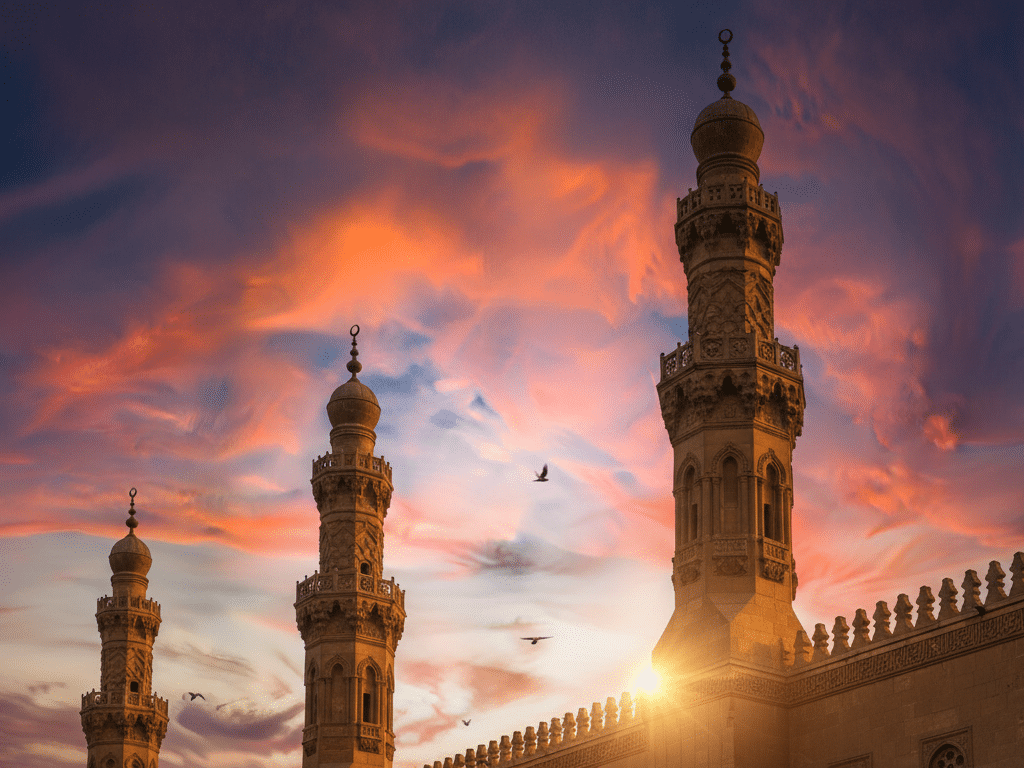
- The Five Minarets: The mosque is famous for its distinct minarets, each added by a different ruler. The double-headed minaret of Sultan al-Ghuri is a masterpiece of Mamluk engineering and aesthetics.
- The Central Courtyard: A vast open space surrounded by porticoes, it has served as a gathering place for scholars, students, and revolutionaries for over a thousand years.
The architecture and stories of Al-Azhar emphasize its role as a beacon of knowledge. It has survived numerous political shifts, remaining a global authority on Islamic jurisprudence and Arabic language. For the traveler or historian, Al-Azhar is a living archive where every column and inscription tells a story of intellectual resilience and spiritual continuity.
Al-Qarawiyyin Mosque: The World’s Oldest University
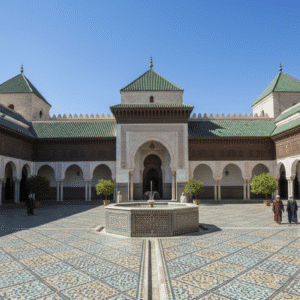
In the winding streets of the Fes Medina in Morocco lies the Al-Qarawiyyin Mosque. Founded in 859 AD by Fatima al-Fihri, the daughter of a wealthy merchant, it holds the Guinness World Record for the oldest continuously operating educational institution in the world. Its architecture is a stunning example of the Maghrebi style, characterized by its sobriety and intricate detail.
Artistry and Academic Legacy
- Andalusian Influence: During the Almoravid expansion, the mosque was adorned with exquisite wood carvings and Zellij tile work, influenced by the artisans of Islamic Spain.
- The Historical Library: Recently restored, the library houses over 4,000 rare manuscripts, including a 9th-century Quran and early medical texts that influenced European science.
- The Water System: The mosque features a sophisticated system of fountains and channels, highlighting the essential role of water for both purification and aesthetic cooling in Moroccan architecture.
When we examine the architecture and stories of Al-Qarawiyyin, we see a profound legacy of female patronage and the deep-rooted value placed on education. It served as a bridge between the East and West, where scholars like Ibn Khaldun and even Pope Sylvester II are said to have studied, illustrating the mosque’s role as a global center for cross-cultural exchange.
Universal Elements of Islamic Architectural Design
While regional styles vary significantly from the terracotta of West Africa to the blue tiles of Central Asia, several core elements unite historical mosques. These features are meticulously designed to facilitate communal worship while expressing the metaphysical concepts of the faith.
Key Architectural Features
- The Minaret: Originally a visual landmark and a place for the call to prayer, it evolved into a symbol of the mosque’s presence in the urban landscape.
- The Dome: Representing the celestial vault, domes are often decorated with muqarnas (stalactite vaulting) or intricate calligraphy to draw the worshipper’s gaze upward.
- Geometric and Floral Patterns: In place of figurative images, Islamic art utilizes complex geometry and arabesque patterns to represent the infinite nature of the Divine.
The architecture and stories of these structures are inextricably linked to the practical and spiritual needs of the community. Whether it is the acoustic perfection required for the Imam’s voice to reach thousands or the placement of windows to catch the breeze in hot climates, every design choice serves a higher purpose of harmony and balance.
Conclusion
The historical mosques of the world are far more than static monuments; they are living testaments to the enduring power of faith and the brilliance of human craft. By studying the architecture and stories of Al-Azhar, Al-Qarawiyyin, and the Great Mosque of Cordoba, we gain a deeper appreciation for the diversity of human history. These sites challenge us to look beyond the stone and see the spirit of the people who built them, reminding us of a time when art, science, and spirituality were harmoniously intertwined. For writers and bloggers, these landmarks provide endless inspiration for stories of cultural heritage and architectural wonder.
Are you ready to explore more historical wonders? Start your journey by researching these landmarks or visiting them to witness the legacy of the past firsthand.